
The Complete Local SEO Guide for Landscaping Companies
Build map-pack visibility, branch pages and review systems around the services your crews can deliver profitably.
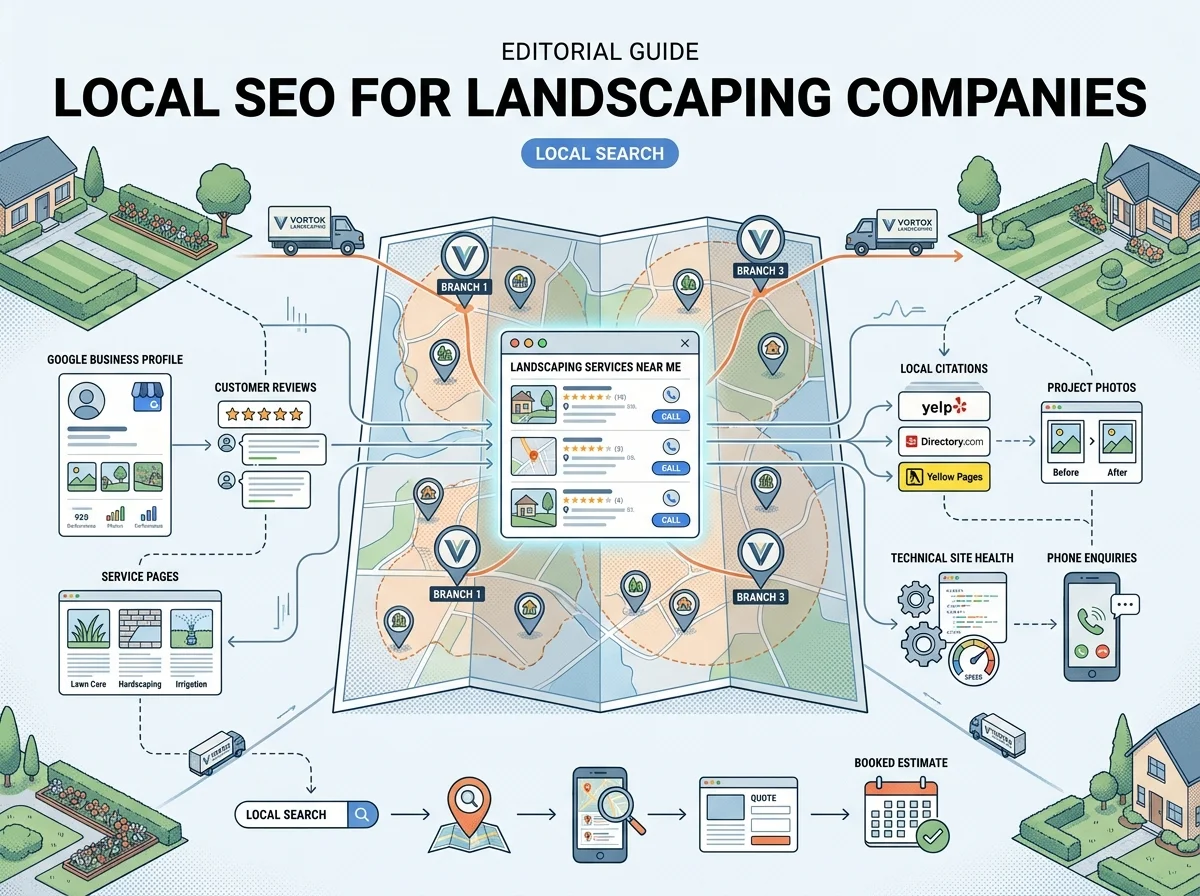
Local SEO works when visibility follows the operation
Local SEO for landscaping companies connects each real branch to the services it sells, the territories its crews can cover, the proof buyers can verify and the phone or estimate path that follows. The goal is not to appear everywhere. The goal is to appear for the work you want, in the places you can serve, then track whether that visibility becomes qualified calls, walk-throughs and booked estimates.
The costly problem
A landscaping company can rank for broad terms and still receive the wrong calls. Weak branch ownership, duplicate listings, thin location pages and inconsistent reviews create visibility without useful booked work.
What this guide delivers
This guide shows how to connect Google Business Profile management, service pages, local proof, review requests, branch ownership and reporting to qualified calls and estimates.
The local search operating system
Visibility sits in the middle of the system. Branch accuracy and delivery capacity come before rankings; booked work and retention come after them.
What this guide covers
- Set the local search baseline before changing anything
- Define branch, territory and service ownership
- Build a useful Google Business Profile
- Create service-area pages with operating detail
- Build a review process after completed work
- Fix duplicates and inconsistent listings
- Connect local pages through internal links
- Track qualified calls, forms and booked estimates
- Run the monthly local search review
Set the local search baseline before changing anything
Begin with account ownership, not keywords. List every Google Business Profile, website branch page, tracking number, directory listing and review destination. Record who controls each asset and which branch receives the calls. A profile nobody can access is an operating risk, not a marketing inconvenience.
Then map visibility to the company's real service mix. A branch may rank for lawn care while the schedule needs irrigation repairs or commercial enhancements. Record current map visibility, organic landing pages, qualified calls and booked estimates by service. This separates useful visibility from rankings that create no capacity-fit work.
Build the baseline before changing categories, pages or listings. Otherwise the team cannot tell whether the next movement came from a better system, a seasonal demand shift or a reporting change.
- Confirm primary owner and backup access for every branch profile.
- Record the branch phone, hours, service territory and page URL in one place.
- Separate branded searches from service searches.
- Tag calls and forms by qualified, existing customer, wrong service and outside territory.
Define branch, territory and service ownership
A multi-branch operator needs one written rule for who owns an enquiry. Draw service territories from profitable drive time and crew coverage, not from broad county boundaries. Decide how overflow works, which branch handles commercial accounts that cross territories and what happens when one location is full.
Each branch profile and page should reflect the services that branch actually sells. If one branch has an irrigation technician and another does not, the local search system should show that difference. Consistency does not mean making every branch identical. It means using the same decision standard across different operations.
Branch ownership also affects reviews and service recovery. The branch that delivered the work should own the response, while central marketing keeps the language, escalation and access standards consistent.
Branch-to-service ownership map
| Branch | Services sold | Primary territory | Lead owner | Overflow rule |
|---|---|---|---|---|
| Branch A | Maintenance, enhancements | Core route clusters | Office manager | Route to Branch B when backlog exceeds limit |
| Branch B | Design-build, irrigation | Project territory | Estimator | Route repair calls to technician queue |
| Central | Commercial contracts | All approved territories | Commercial lead | Assign after property and capacity review |
Replace the example labels with real branches and service ownership. The table should match the profile, website and CRM.
Build a useful Google Business Profile
A useful profile answers the buyer's first questions before the call: what the company does, when it is open, how the branch is contacted and whether the work shown matches the service requested. Categories and services should stay narrow enough to represent the branch accurately.
Photos need operating context. Use crews, equipment, completed projects, property types and seasonal work. Avoid filling the profile with generic stock images or graphics that hide what the company actually delivers. Update hours before holiday periods, snow events and seasonal schedule changes.
Treat questions, messages and calls as sales or service records. A profile can generate demand outside office hours, so the response path must include overflow, missed-call recovery or a clear next-business-day expectation.
Create service-area pages with operating detail
A service-area page needs more than a place name. Explain which services the company runs there, the property types it serves, how crews reach the area, what seasonal demand looks like and what makes the next step different for that territory. This is the paragraph a generalist agency cannot copy.
Use local proof only when it is real and approved. A named project, property type, crew route, review or branch team carries more weight than a page full of location modifiers. Where public proof is limited, show the process and state the limitation plainly.
Every page should connect up to the relevant service, across to the branch and forward to proof, packages or a helpful guide. Local pages should help a buyer move, not sit as isolated search inventory.
Build a review process after completed work
Reviews work when the trigger matches a completed relationship. Use a reliable milestone such as approved completion, final walk-through, paid recurring cycle or resolved service recovery. Do not request a review while a callback, billing dispute or open complaint remains active.
The message should identify the completed service, ask plainly and give one link. Never script the customer's wording or create reviews internally. The system should record request sent, review received, issue raised, no response and opt-out so the same customer is not asked repeatedly.
Responses should name the service or experience without exposing private details. Branch managers need a clear escalation path for negative feedback because a public response cannot replace fixing the account.
Review request and escalation flow
| Job status | Automation action | Human owner | Public request? |
|---|---|---|---|
| Completed, no open issue | Send review request | Account owner monitors | Yes |
| Completed, callback open | Create service task | Operations manager | No |
| Billing dispute open | Pause all requests | Finance or owner | No |
| Review received | Record and respond | Branch manager | Already complete |
The service-recovery gate matters more than the message wording.
Fix duplicates and inconsistent listings
Duplicate profiles, old phone numbers, previous addresses and inconsistent branch names split trust signals and confuse the buyer. Keep a change log for every correction, including who requested it, what evidence was supplied and whether the listing is still visible.
Do not create a new profile simply because a duplicate is difficult to resolve. First confirm the company has a genuine operating location and that the branch meets the platform's current eligibility requirements. Where a listing cannot be edited, document the limitation and protect the website, phone and primary profile data that the company controls.
Run the duplicate check before a rebrand, acquisition or office move. These changes produce the most expensive local search cleanup when nobody records the old assets.
Connect local pages through internal links
Internal links tell the buyer and search engine how branches, services, industries, proof and pricing relate. A branch page should link to the services sold there, while service pages should link to relevant branches and case studies. The anchor text should name the destination rather than say read more.
Use the site architecture to prevent two pages from competing for the same query. A local service page answers the service-in-territory decision. The main service page explains the full method. The branch page proves the operating presence. Give each page a clear job.
When choosing between two valid links, send the reader further down the buying journey. A link to a relevant case study or package is usually more useful than another general article.
Track qualified calls, forms and booked estimates
Map visibility, profile actions and organic traffic are leading indicators. The operating report needs qualified calls, form submissions, booked estimates, won work and branch ownership. Classify wrong service, outside territory, existing customer, vendor and employment calls separately.
Call tracking should preserve the source without breaking the public branch number or customer experience. Form tracking should carry the landing page, service, branch and campaign context into the CRM or field software. Where attribution is incomplete, state the gap instead of filling it with assumptions.
Review the report with the office and branch managers. A channel can look weak because calls are not answered, forms are routed late or the branch is full. Marketing cannot diagnose the problem alone.
Run the monthly local search review
Use one monthly operating review to check profile access, hours, categories, services, photos, duplicates, branch pages, reviews, calls, forms and booked work. The meeting should end with named actions and owners, not a ranking screenshot.
Adjust the system to the season. Before the spring rush, confirm response coverage and the services crews can absorb. Before fall, strengthen cleanup, renewal and snow information. During the January quiet, fix listings, branch pages, automation and reporting rather than buying demand the operation cannot use.
- Local SEO compounds when the operating data stays accurate. It deteriorates quickly when the business changes and the public information does not.
What we recommend
Start with one branch and one priority service before expanding the system.
Keep one central record for branch data, profile access, phone routing and website ownership.
Publish local pages only where the company can prove real coverage and operating detail.
Tie every review request to a completed job and an open-issue check.
Report qualified calls and booked estimates alongside rankings and profile actions.
Put the guide into operation
Audit profiles, access, branch data and duplicate risks.
Map services, territories, owners and local pages.
Fix profile content, reviews, links and call routing.
Publish the monthly scorecard and assign actions.
The numbers to review
Local search scorecard
| Measure | What it answers | Review frequency | Owner |
|---|---|---|---|
| Qualified calls by branch | Is visibility reaching the right office? | Weekly | Office manager |
| Booked estimates by service | Is demand matching capacity? | Weekly | Branch manager |
| Review eligibility and completion | Is the process following completed work? | Monthly | Client partner |
| Profile and page accuracy | Does public information match the operation? | Monthly | Marketing owner |
| Won work from local sources | Is visibility becoming revenue? | Monthly | Owner or finance |
A scorecard is useful only when every branch uses the same definitions.
Questions owners ask before acting
How long does local SEO take for a landscaping company?
Local SEO usually needs several months of consistent profile, website, review and citation work before the full effect appears. Operational fixes can improve call quality sooner, especially when the current profile lists the wrong services, hours or phone path. The timeline also depends on competition, branch history and whether the company already has real local proof.
Should every service area have its own page?
No. Publish a service-area page only when the company genuinely serves the territory and can add unique operating detail, proof and a useful next step. Thin pages that change only the place name create maintenance work and can compete with stronger service or branch pages.
Can we use one Google Business Profile for several branches?
Each genuine branch should follow the platform's current eligibility rules and have accurate ownership, contact and website information. Do not create extra profiles for mailboxes or temporary yards. Central marketing can govern standards while each branch supplies local hours, service changes, photos and issue context.
What should we measure besides map rankings?
Measure qualified calls, form submissions, booked estimates, won work, branch ownership and the reasons enquiries fail. Rankings show visibility. They do not show whether the office answered, the territory fit, the estimator booked or the crew could deliver the work.
Rankings are one part of it. We run the whole system.
We connect local visibility to websites, call handling, reporting and the crew capacity behind the schedule. Growth packages start at $2,000/mo; ad spend is excluded.
Want to get informed and stay ahead of the curve?
The newsletter carries new chapters, seasonal updates and the working files that go with each guide.