
Facebook Ads That Produce Qualified Landscaping Leads
Use project proof, clear qualification and fast follow-up to turn paid social attention into scheduled landscaping work.
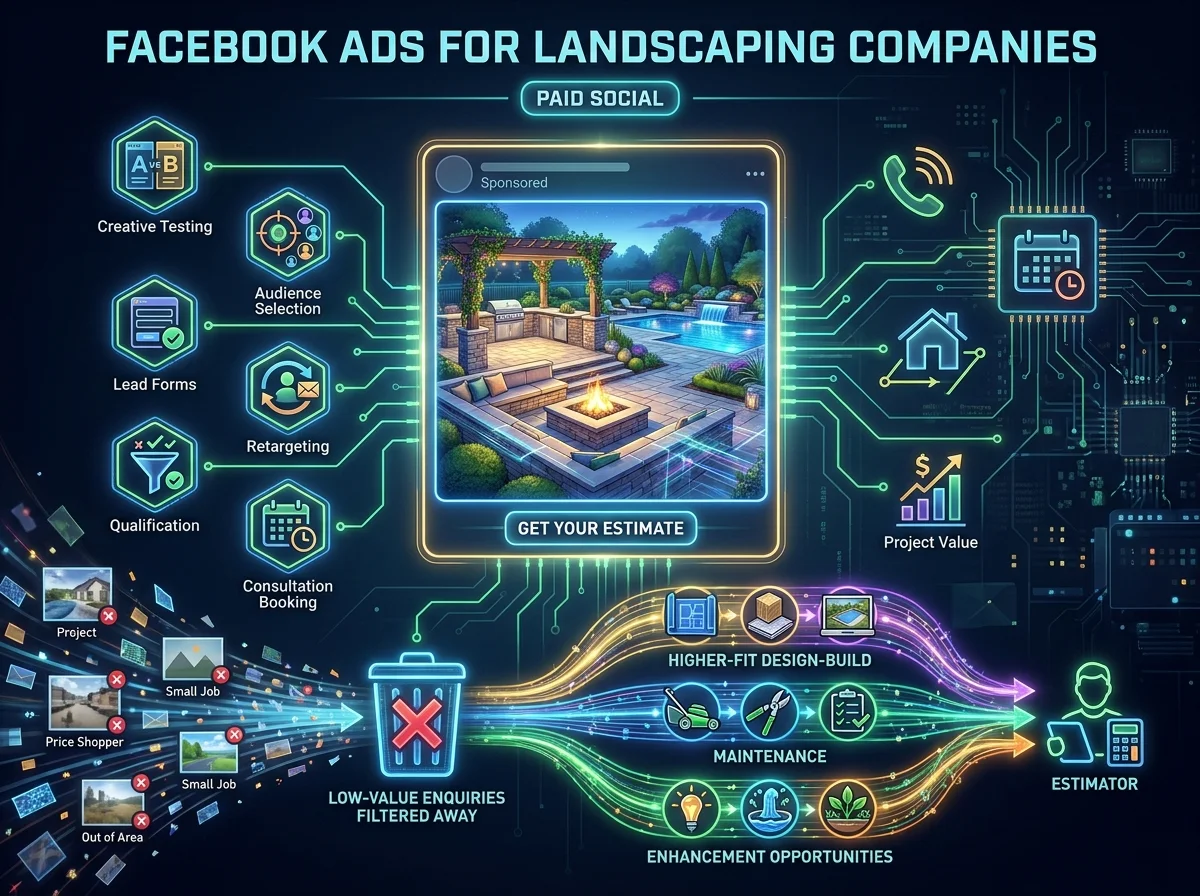
Facebook ads work when the offer sells the next decision
Facebook Ads for landscaping companies should not ask a cold audience to buy a full project. They should show relevant proof, define the service and buyer, then move the prospect to a useful next decision such as a project-fit review, design consultation, maintenance walk-through or seasonal booking. Qualification and response determine whether attention becomes scheduled work.
The costly problem
A strong project image can generate attention and still send price shoppers to the estimator. Generic offers, broad lead forms and slow response turn paid social into a list of names rather than scheduled work.
What this guide delivers
This guide shows how to choose one service offer, build useful creative, qualify project fit, connect the ad to the landing page and recover interested prospects before they call another contractor.
The ad-to-estimate conversion path
Paid social creates attention first. The offer, qualification and human response decide whether the attention is commercially useful.
Choose the service and buyer worth targeting
Start with one service line, one buyer and one next step. Design-build, recurring lawn care, commercial maintenance, irrigation and snow have different purchase decisions. A generic landscaping campaign forces the prospect and estimator to sort out the offer after the lead arrives.
Choose services with enough visual proof, sales capacity and margin to justify paid attention. A design-build firm may promote signed design agreements in winter. A commercial operator may promote property walk-throughs before budget season. A lawn care company may protect route density by targeting only selected clusters.
Write the disqualification before the creative. Record the wrong property types, territories, job sizes, timing and service requests so the campaign can avoid buying them.
Build the offer around the next decision
The ad should sell the next reasonable commitment. A homeowner may book a project-fit call. A property manager may request a maintenance walk-through. A snow buyer may review pre-season coverage. This lowers the decision burden while keeping the sales process honest.
Name what the prospect receives and what happens next. A written project review, thirty-minute consultation, site walk-through or service availability check is clearer than get a quote. State the response expectation and any qualification required.
Avoid discounting through winter simply because demand is lower. Use the quieter months to sell planning, design, renewals, automation or next-season preparation.
Service and offer fit
| Service | Best next decision | Key qualification | Proof to show |
|---|---|---|---|
| Design-build | Project-fit consultation | Project type, timing, investment range | Completed project and design process |
| Commercial maintenance | Property walk-through | Property type, scope, contract date | Portfolio, reporting and service standards |
| Irrigation | Diagnostic booking | Issue, property, urgency, territory | Technician process and repair scope |
| Snow | Coverage review | Property, priority, contract timing | Equipment, route planning and communication |
A useful offer reflects how the service is actually bought.
Create project-led ad concepts
Use real approved project photography, crew process and before-during-after evidence. The strongest creative explains a decision: why the grade changed, how drainage was solved, what the maintenance scope includes or how lighting changed the property after dark.
Build several concepts from one project. A wide finished view can sell the outcome. A detail shot can prove craftsmanship. A short sequence can explain process. A client-approved quote can reduce risk. Each concept should carry one idea rather than a collage of everything the company does.
Keep text on the image short and readable. The primary message belongs in the ad copy and landing page. The creative needs to earn attention and make the service obvious without pretending the project belongs to an invented client.
Qualify service, property, timing and scope
Lead forms reduce friction, which can increase both useful and poor-fit enquiries. Ask only questions that change routing or priority: service, property type, territory, timing, decision-maker and project or contract range. Explain why a sensitive question is needed.
Split forms by service. A design-build prospect may need to confirm investment range and decision-makers. A maintenance prospect may need property type, acreage and contract timing. One form cannot qualify both without becoming confusing.
Route poor-fit requests to a polite decline or useful resource instead of leaving them unanswered. The brand is still judged by how it handles the wrong enquiry.
Lead-form qualification matrix
| Question | Why ask it | Routing decision | Do not ask when |
|---|---|---|---|
| Service needed | Separates offers | Send to correct team | Never omit |
| Property type | Changes scope and proof | Residential or commercial path | When all work is one type |
| Timing | Sets priority | Immediate, future or nurture | When the service has one fixed window |
| Project or contract range | Protects estimator time | Qualified or alternate path | When price cannot be discussed responsibly |
Every question should change a decision. Remove fields nobody uses.
Match the landing page to the ad
The landing page should repeat the service, project type, proof and next step shown in the ad. Do not send a prospect from a detailed patio campaign to a homepage that opens with general lawn care.
Explain fit early. Include service range, territory, process, timeline, approved proof and what the consultation covers. Keep the call and form path easy on mobile. Use one primary action and remove navigation that distracts from the decision when appropriate.
Test the thank-you and routing path. The confirmation should say when a person responds, what information will be reviewed and how the prospect can add context.
Run immediate lead response and routing
Paid social intent cools quickly because the prospect was not actively searching when the ad appeared. Send an immediate confirmation, then assign a named person with the lead details, creative source and qualification answers attached.
Use missed-call recovery, SMS or email carefully. Automation should acknowledge and collect context, while a person owns the consultation or estimate. Stop the sequence when the prospect books, declines, opts out or needs a service-resolution path.
Peak season requires extra response coverage. If the office cannot answer or call back inside the published expectation, restrict spend before increasing volume.
Measure booked consultations and won work
Report cost per qualified lead, booked consultation, show rate, design agreement, estimate and won work where the sales data supports it. Cheap lead cost can hide weak quality, slow response or no-shows.
Compare creative by the quality and stage it produces. A project image may generate fewer forms but more booked consultations than a broad offer. That is the better creative when the objective is profitable work.
Record why leads fail: wrong service, wrong territory, budget, timing, no response, duplicate or lost to competitor. These reasons improve creative, form questions, landing pages and sales follow-up.
What we recommend
Run one service offer at a time so the creative and qualification stay clear.
Use approved project proof rather than generic landscape imagery.
Sell the consultation, walk-through or planning step before the installation.
Assign a human owner and response deadline before launch.
Measure booked consultations and won work, not form volume alone.
Put the guide into operation
Choose service, buyer, offer and disqualification rules.
Build creative, form, page and response workflow.
Launch a controlled test with sales ownership.
Review booked outcomes, creative quality and failure reasons.
The numbers to review
Paid social scorecard
| Measure | What it reveals | Review frequency | Action |
|---|---|---|---|
| Qualified lead rate | Whether targeting and form fit the offer | Weekly | Change audience, creative or questions |
| Response time | Whether the office can use demand | Daily | Restrict spend if response slips |
| Booked consultation cost | Whether attention becomes a sales event | Weekly | Compare by creative and service |
| Show rate | Whether expectations and follow-up work | Weekly | Improve confirmation and reminders |
| Won work and margin | Whether the campaign earns its place | Monthly | Scale only with reliable data |
A low form cost is not success when the estimator cannot book the prospect.
Questions owners ask before acting
Do Facebook ads work for landscaping companies?
Yes, when the service has useful visual proof, a clear buyer, a defined next step and fast follow-up. Paid social is strongest for project-led services, seasonal planning, remarketing and areas where the company can show work before the prospect begins an active search.
Should we use instant forms or a landing page?
Use instant forms when low friction and quick qualification matter, then route the answers into a controlled follow-up. Use a landing page when the buyer needs more process, proof, project range or comparison before acting. Many campaigns use both and compare booked outcomes.
How much text should go on the ad image?
Keep image text short enough to read on a phone. Use the visual to make the service and outcome clear, then use the ad copy and landing page for process, fit and qualification. Dense graphics often look like a report rather than a project someone wants.
What should we do with leads that are not ready now?
Move future-fit prospects into a permission-based nurture path with useful project planning, seasonal timing or availability information. Give the record a next review date and stop when the prospect declines or opts out. Do not leave every unready lead in the active estimator queue.
Ad creative is one part of it. We run the whole follow-up path.
We connect paid social to project pages, qualification, call handling, automation, reporting and the team that has to close the work. Growth packages start at $2,000/mo; ad spend is excluded.
Want to get informed and stay ahead of the curve?
The newsletter carries new chapters, seasonal updates and the working files that go with each guide.