
Content That Books Estimates, Not Just Traffic
Write service pages, project stories and decision-stage content around buyer questions, job economics and proof.
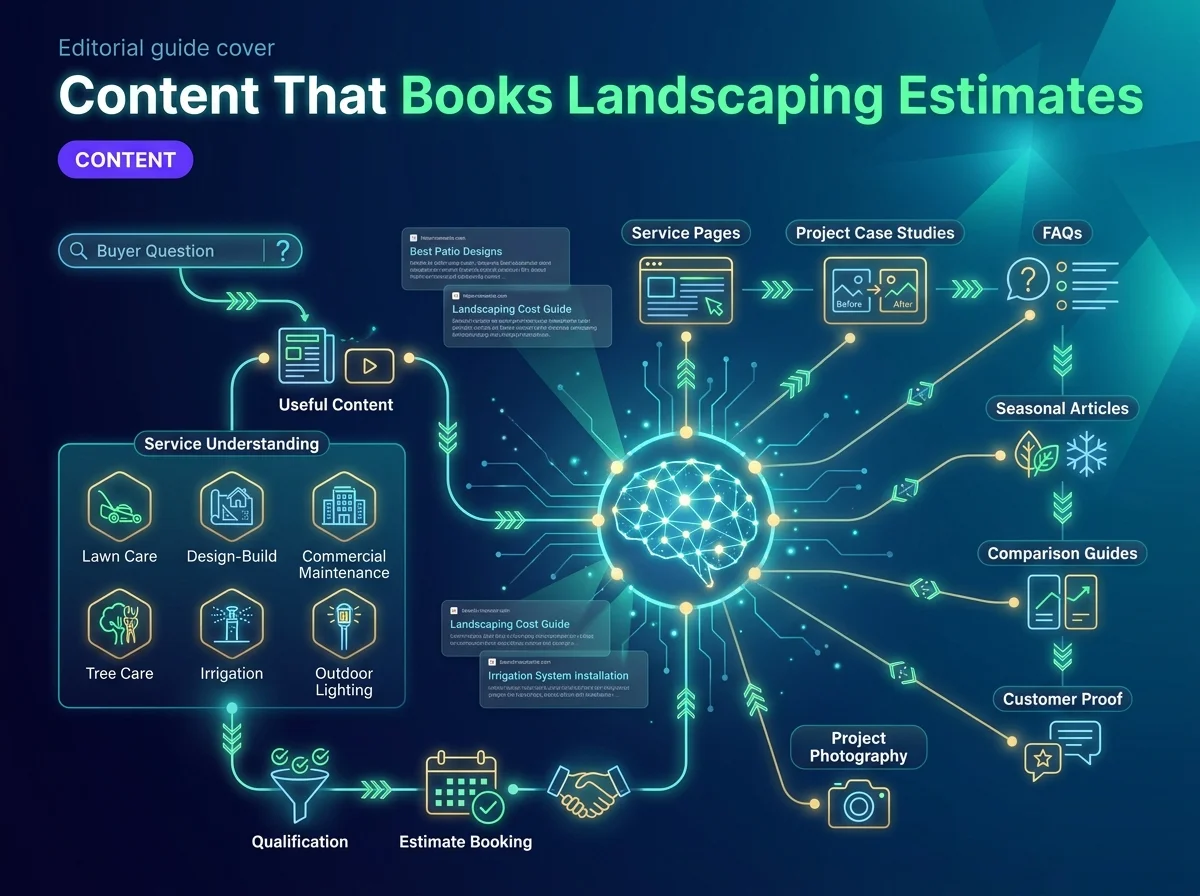
Useful content answers the sales question before the call
Landscaping content marketing should help the right buyer understand service fit, process, timing, proof, price signals and the next step. It starts with real sales conversations and operating constraints, then turns those questions into service pages, comparisons, project stories and guides. Traffic matters only when the content assists qualified calls, estimates, contracts or renewals.
The costly problem
Traffic has little value when the content attracts students, DIY readers or homeowners seeking services the company does not want. Generic articles also fail to help a property manager compare providers or approve a bid.
What this guide delivers
This guide explains search intent, service-page structure, project proof, internal linking, answer-first writing, seasonal topics and the measurement path from page visit to booked estimate.
The content-to-booked-estimate path
The topic earns attention. The page argument, proof and internal path determine whether the attention helps the buyer act.
Choose topics from the sales conversation
Collect the questions asked before estimates, during walk-throughs, after proposals and before renewals. Note the language used by homeowners, property managers, HOA boards, facility managers and general contractors. These questions are better topic inputs than a generic keyword list.
Add operating questions the sales team avoids: service minimums, timing, crew availability, project phases, licensing, route coverage, maintenance scope and winter constraints. Direct answers qualify the buyer and reduce repetitive calls.
Prioritise topics that support a valuable service or sales stage. A guide on commercial maintenance reporting may assist bids. A project-planning article may support design agreements. A broad gardening topic may create traffic with no path to the company's offer.
Separate service, comparison and problem intent
Service intent evaluates a provider and needs scope, process, price signal, proof and timing. Comparison intent needs a verdict, criteria and recommendation. Problem intent needs a direct answer and a path to the relevant service. Treating all three as blog posts produces weak pages.
Use one primary keyword and one clear page job. Do not create multiple pages targeting the same phrase with slightly different wording. Differentiate close topics by buyer and decision, not synonym swapping.
Answer question-shaped queries in the first paragraph. AI assistants and busy owners both prefer a direct answer before background. Qualify the answer after committing to it.
Search intent to page-type map
| Buyer intent | Best page type | Must answer | Primary next step |
|---|---|---|---|
| Evaluate a service | Service page | Scope, process, timing, proof and price signal | Book estimate or audit |
| Compare tools or approaches | Comparison guide | Verdict, criteria, trade-offs and fit | Choose path or service |
| Solve a problem | How-to guide | Direct answer, method and risk | Use guide or request help |
| Evaluate provider proof | Case study | Constraint, work, approved result and limits | See service or package |
The page type follows the decision, not the content calendar.
Write service pages that answer fit early
A service page should name who buys the service, the problem it solves and what changes in the business. Then explain components, tools, process, delivery, seasonality, cost or package fit and decision-stage questions.
Use the language the buyer uses: booked jobs, estimates, route density, crew hours, maintenance contract, renewal, spring rush, snow event, Aspire, Jobber or LMN where relevant. Avoid agency abstractions that could appear on a website in any industry.
Admit the limit. SEO may not move before month four. Ad spend is excluded. A tier may not include a build. Transparency answers the objection before the sales call.
Service-page argument structure
| Section | Question answered | Evidence | Link destination |
|---|---|---|---|
| Hero | Is this for me and what changes? | Clear category and outcome | Primary action |
| Problem | Do you understand the cost? | Owner language and operating detail | Relevant guide |
| Process | How is the work done? | Named tools and steps | Sibling service |
| Proof | Why should I believe it? | Approved case study or process proof | Case study |
| Package | What does it cost and replace? | Published tiers and exclusions | Packages |
| FAQ | What stops the decision? | Direct answers | Audit or related service |
A reader scanning the headings should understand the full argument.
Turn projects into useful proof
A useful project story explains the original constraint, what the company found, what changed, what was measured and what remains limited. Use named client figures only with written approval. Where approval does not exist, publish the process and say so.
Project photography should show before, work in progress, detail and finished outcome. Add captions that explain access, drainage, route, material, schedule or property-management decisions. Images become proof when the buyer understands what they demonstrate.
Case studies should link to every service used, the relevant industry, package and next action. A testimonial without full name, role and company is weaker than no testimonial because it reads as invented.
Build internal links around the buying journey
Link service pages to sibling services, category hubs, industries, packages, proof and helpful guides. Link guides to the service that solves the problem and to related articles that help the reader continue. Use anchor text that names the destination.
Internal links are not a related-posts grid placed at the bottom. Put them inside sentences where the reader is already thinking about the next decision. Choose the destination further down the buying journey when two links are equally relevant.
- Avoid repeating the same anchor across dozens of pages. Variation should remain descriptive and natural.
Measure qualified visits and booked estimates
Report organic landing sessions, qualified calls and forms, booked estimates, assisted conversions and won work where attribution is reliable. Separate branded traffic from non-branded service discovery and classify poor-fit enquiries.
Use Search Console and analytics to find pages with visibility but weak click-through, visits but no action, or actions that fail qualification. The solution may be a better title, stronger first answer, clearer fit, proof, internal link or response workflow.
Review content with sales and operations. Search data shows what people ask. The office shows what they mean. Operations shows whether the company wants more of the work.
What we recommend
Build the topic list from sales, service and renewal conversations.
Match each query to the correct page type before writing.
Answer the primary question inside the first eighty words.
Use approved proof or transparent process evidence, never invented results.
Measure qualified enquiries and booked estimates alongside traffic.
Put the guide into operation
Collect sales questions and map commercial intent.
Choose page types, keywords and internal destinations.
Write answer-first pages with operating detail and proof.
Publish measurement and review with sales and operations.
The numbers to review
Content performance scorecard
| Measure | What it answers | Review frequency | Action |
|---|---|---|---|
| Non-branded landing visits | Is the page earning discovery? | Monthly | Improve coverage and titles |
| Qualified actions | Does the content attract fit? | Monthly | Clarify service and qualification |
| Booked estimates assisted | Does the page help the sale? | Monthly | Strengthen proof and next links |
| Internal path usage | Can readers continue the decision? | Monthly | Improve contextual links |
| Content failure reasons | Why does traffic not convert? | Quarterly | Rewrite or consolidate |
Traffic without a commercial path is a publishing cost, not a growth result.
Questions owners ask before acting
How often should a landscaping company publish content?
Publish at the pace the company can maintain with useful operating detail, approved proof and internal links. One strong service page or guide can be more valuable than several generic posts. Plan around service priorities and seasonal questions rather than a fixed weekly quota.
What topics generate landscaping leads?
Topics close to a buying decision generate the strongest opportunities: service scope, cost, timing, project planning, contract comparison, maintenance standards, local availability, proof and common objections. Broad DIY topics can earn traffic but often need a clear path to a relevant service.
Should AI write landscaping content?
AI can help organise notes, structure drafts and identify gaps, but a knowledgeable person should supply the field detail, verify claims, approve proof and edit the final page. The output needs seasonality, crew capacity, service economics and the company's real process.
How long should a landscaping service page be?
Write enough to answer the buyer's decision: fit, problem, components, process, proof, timing, price signal and questions. The container and intent matter more than a target word count. Remove repetition and add operating detail where the page feels generic.
Content is one part of it. We run the whole conversion path.
We connect search intent, service pages, proof, internal links, websites, response systems and reporting under one team. Growth packages start at $2,000/mo; ad spend is excluded.
Want to get informed and stay ahead of the curve?
The newsletter carries new chapters, seasonal updates and the working files that go with each guide.