
Social Media Marketing for Landscaping Companies
Build a practical publishing system from project photography, crew knowledge and seasonal work without slowing production.
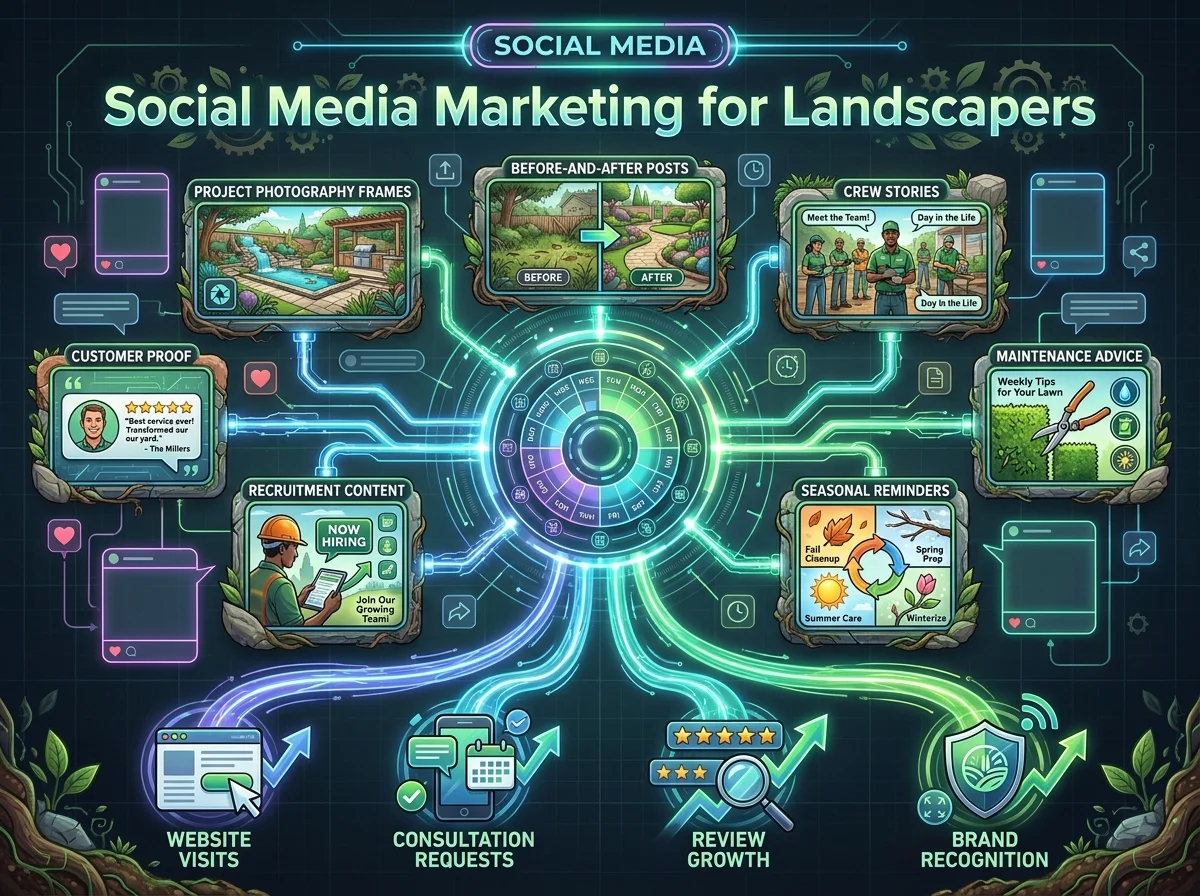
The strongest social content already exists on the job
Social media marketing for landscaping companies works when crews and managers capture real operating evidence, a small team turns it into project stories and useful explanations, and each channel has a business job such as proof, recruiting, remarketing or lead generation. The goal is not to post every day. It is to make the work easier to trust and easier to distribute.
The costly problem
Most landscaping social accounts post finished lawns without explaining the decision, process or result. The feed stays active, but it does not support estimates, recruiting, contract credibility or remarketing.
What this guide delivers
This guide shows how to plan content pillars, capture useful field material, publish proof, support paid campaigns, manage comments and connect social activity to website and sales actions.
The field-to-social content workflow
The crew captures evidence. Marketing turns it into a usable asset. Sales, recruiting and paid media reuse it.
What this guide covers
Choose the business job for each channel
Decide what each channel should do. Instagram may show visual project proof. Facebook may support homeowner reach and remarketing. LinkedIn may strengthen commercial credibility and recruiting. YouTube may explain process. The website remains the owned destination.
Do not copy the same post everywhere without considering the buyer and format. A property walk-through insight may work as a LinkedIn post, a short video and a commercial service-page proof block, but each version needs a different opening and action.
- Give every channel one primary job and one measure. Follower count is not a business job.
Channel role and content fit
| Channel | Primary business job | Best content | Primary action |
|---|---|---|---|
| Visual proof and remarketing | Projects, details, process, crew | Visit service page | |
| Homeowner reach and community context | Seasonal services, projects, local updates | Book or enquire | |
| Commercial credibility and recruiting | Walk-throughs, standards, leadership, hiring | Visit commercial or careers page | |
| YouTube | Process explanation and long-form proof | Guides, project walkthroughs, webinars | Watch then visit website |
Choose the channel from the buyer and business job, not from habit.
Build content pillars from real operations
Use a small set of repeatable pillars: completed projects, process and craftsmanship, crew knowledge, seasonal advice, property-management standards, customer proof, recruiting and company decisions. These pillars should reflect the services the company wants to sell.
Each post needs context. Explain the access problem, design choice, maintenance standard, safety step, route decision or callback fix. The finished lawn alone rarely shows why the company should be hired.
Keep private property details, customer information and unapproved claims out of the content. Obtain permission where required and maintain a simple approval record.
Create a field capture process crews can follow
Crews should not become content producers. Give them a short capture standard: one wide shot, two details, one progress step, one issue solved and a short voice note explaining what happened. A crew lead or project manager can complete it in minutes when the process is clear.
Use named folders or a simple upload form by job, service and date. Record whether the customer approved publication and whether faces, house numbers, vehicles or documents need to be hidden.
- Marketing should review quality, crop, caption and file names. The field team supplies truth; the content team turns it into publishable evidence.
Field-photo capture checklist
| Capture | Purpose | Minimum standard | Approval check |
|---|---|---|---|
| Wide property view | Shows scope | Clean frame and level horizon | Customer or property permission |
| Detail shot | Proves craftsmanship | Close enough to see material or finish | Remove private identifiers |
| Progress step | Explains process | One clear operation | Safety and PPE visible |
| Issue solved | Adds commercial context | Before plus explanation | No unsupported claim |
| Crew note | Provides caption detail | Service, constraint and decision | Employee permission where needed |
The capture standard should take minutes, not slow production.
Turn projects into useful stories
Use a simple story shape: the property or buyer, the constraint, what the team found, what changed and what the finished work proves. Add the season and service where useful. A commercial maintenance post may explain reporting and renewal. A design-build post may explain grade, drainage or material choice.
Create several assets from one project: a short video, photo carousel, before-and-after, website case note, estimator follow-up asset and paid ad concept. This reduces the need to invent new topics every week.
Only use named results and customer quotes with approval. If the content is illustrative or a composite, label it and do not place it inside client proof.
Support recruiting and commercial credibility
Recruiting content should show the work, equipment, training, standards, team expectations and seasonal reality. Avoid pretending every day is a finished-project photo. A qualified crew leader wants to understand the operation they are joining.
Commercial buyers look for consistency, communication and documentation. Show property walk-throughs, safety, scheduling, reporting, equipment readiness and service recovery, not only flowers and stripes.
- Keep employee consent and customer privacy clear. Never use a team member's image or story as a marketing asset without permission.
Connect organic posts to paid campaigns
Organic content reveals which projects, questions and formats earn useful attention. Turn strong approved assets into paid creative, but rebuild the message around the campaign objective and qualification path.
Retarget visitors and engaged audiences with service-specific proof or a clear next step. Exclude won customers and irrelevant records where the platform and data policy allow. Organic reach does not replace a landing page, lead form or response system.
Paid and organic teams should share one asset library, approval standard and naming system so the same proof can support the website, proposal, email and ad without losing context.
Track enquiries, assisted visits and proof usage
Record direct enquiries, profile visits, website sessions, retargeting audiences, recruiting applications and proof assets used in sales. Social often assists the decision rather than receiving the final attribution.
Ask sales which posts or projects prospects mention. Track links and campaign sources where practical, but do not invent precision when a buyer moves between devices or channels. State the attribution limit.
Review the content system monthly. Which service needs proof? Which crews are overloaded? Which seasonal questions are arriving? The calendar should follow the operation.
What we recommend
Give each channel one business job and one useful measure.
Build content pillars from services, proof, recruiting and seasonality.
Keep field capture short, structured and permission-based.
Turn one approved project into several assets instead of inventing daily posts.
Connect social proof to website pages, proposals, remarketing and sales follow-up.
Put the guide into operation
Choose channel roles, services and content pillars.
Set the field capture, upload and approval process.
Build the first project stories and reusable asset library.
Publish, distribute and review enquiries and proof usage.
The numbers to review
Social media operating scorecard
| Measure | What it shows | Review frequency | Caution |
|---|---|---|---|
| Qualified enquiries | Direct commercial result | Monthly | Ask service and source |
| Website visits by content | Whether proof moves buyers | Monthly | Use tracked links where practical |
| Paid creative reuse | Whether organic assets support campaigns | Monthly | Keep campaign context |
| Recruiting applications | Whether team content helps hiring | Monthly | Separate volume from fit |
| Proof used in sales | Whether content supports proposals and follow-up | Monthly | Capture sales feedback |
Engagement is useful when it helps a defined business job.
Questions owners ask before acting
How often should a landscaping company post on social media?
Post at the pace the company can support with real projects, useful context and approvals. A consistent weekly or twice-monthly system can outperform daily generic images. The right cadence depends on services, season, asset volume and the channel's business job.
What should landscaping companies post?
Post completed projects, process, crew knowledge, seasonal advice, property-management standards, service recovery, recruiting context and approved customer proof. Explain the decision or problem behind the image so the content supports trust and sales.
Do social media followers become landscaping leads?
Some do, but social often assists the decision through proof, remarketing and repeated exposure. Track direct enquiries, website visits, paid-audience use and the posts prospects mention. Do not judge the channel by follower count alone.
Should crews take photos for marketing?
Yes, when the process is short, safe and permission-based. Ask for a few defined shots and a brief note, then let marketing handle editing, captions, privacy and approval. The crew should not lose production time trying to create polished content.
Posting is one part of it. We run the whole proof system.
We connect field content to websites, paid media, recruiting, proposals, remarketing and reporting without turning the owner into a creator. Growth packages start at $2,000/mo; ad spend is excluded.
Want to get informed and stay ahead of the curve?
The newsletter carries new chapters, seasonal updates and the working files that go with each guide.