
AI Receptionists for Landscaping Companies, Explained End to End
Plan call answering, qualification, booking and human escalation around real services, territories and schedules.
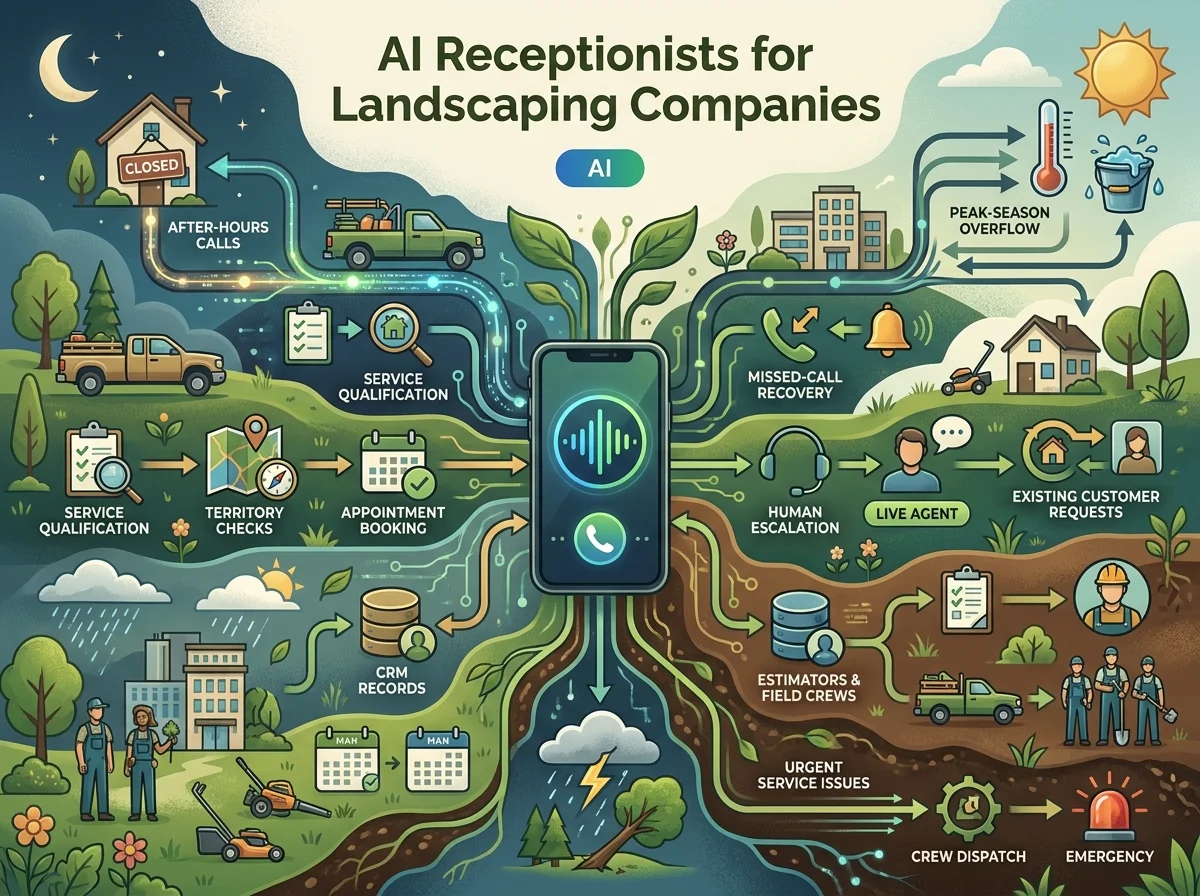
An AI receptionist needs operating rules before a voice
An AI receptionist for a landscaping company should answer approved call types, identify service and customer status, qualify territory and timing, book only within controlled calendar rules and escalate uncertainty to a person. It should support the office during peak weeks and after hours without promising dates, prices or technical answers the operation has not approved.
The costly problem
An AI receptionist can answer every call and still create expensive mistakes. Poor rules can book work outside the service area, promise unavailable dates or send existing customers into a new-lead script.
What this guide delivers
This guide explains call-type mapping, qualification, calendar limits, CRM routing, after-hours handling, human fallback, consent and the review process required before launch.
The inbound call routing model
The system does not treat every ring as a new lead. Customer service, sales, emergencies and vendors need different paths.
What this guide covers
- Decide which calls the system should handle
- Map new leads, customers and service issues
- Write landscaping-specific qualification rules
- Set territory and calendar boundaries
- Build human fallback and escalation
- Connect CRM, estimator and office workflows
- Review consent, recording and data access
- Run daily quality control after launch
Decide which calls the system should handle
List current call reasons before choosing technology. Separate new enquiries, existing customers, schedule changes, billing, service issues, emergencies, vendors, recruiting and internal calls. Record volume, handling time, required information and the person who resolves each type.
Begin with high-volume, low-risk paths such as basic new-lead intake, message capture and approved appointment types. Keep pricing, technical diagnosis, complaints, safety issues and contract changes with trained people until the company has a documented reason to automate them.
Peak and winter call patterns matter. June may require overflow and rapid qualification. February may need after-hours coverage, snow-event routing or next-season planning. The same script should not run unchanged all year.
Map new leads, customers and service issues
The first useful question is often customer status. Existing customers should not repeat a full lead qualification when they need a schedule update or service response. New enquiries need service, property, territory and timing context before a booking path appears.
Create a call-type map with one current owner for each route. Include what happens when the owner is absent, the branch is closed or the call occurs after hours. The system should state when a person will respond rather than creating false immediacy.
Use caller information carefully. Pass context into the CRM or field software where access, consent and data policy allow it. Do not expose customer records simply to make the conversation sound personalised.
Call-type routing map
| Call type | System action | Human owner | Booking allowed? |
|---|---|---|---|
| New service enquiry | Qualify service, property, territory and timing | Sales or estimator | Only approved slots |
| Existing customer schedule | Identify account and capture request | Office or account manager | No new-lead booking |
| Service issue or complaint | Capture facts and escalate | Operations manager | No |
| Emergency or safety risk | State emergency path and escalate | Named emergency owner | No |
| Vendor or employment | Send to correct intake path | Admin or HR | No |
The call reason determines the route. Do not force every caller into one script.
Write landscaping-specific qualification rules
Qualification should reflect the service. A maintenance enquiry may need property type, service frequency and territory. A design-build enquiry may need project category, timing, decision-makers and investment range. A tree or irrigation call may need urgency and a clear safety escalation.
Keep the conversation short enough for a real caller. Ask one question at a time and explain why information is needed when the question could feel sensitive. Give the caller a way to request a person.
Define poor-fit and alternate paths. Outside-territory calls, unsupported services, product enquiries and job applicants should receive a polite, accurate response instead of being sent to an estimator.
Set territory and calendar boundaries
The system should book only approved appointment types, branches, days and buffers. It needs current territory rules and service availability. A calendar integration without operating limits can fill the wrong estimator or promise work after the branch is full.
Use capacity signals where possible. Design consultations, repair windows and commercial walk-throughs may need different durations and owners. Add travel buffers and blackout periods for weather, crew meetings or seasonal events.
When availability is uncertain, capture the request and create a human task. A delayed honest response is better than a confirmed appointment the company cannot honour.
Build human fallback and escalation
Escalate safety, property damage, complaints, technical uncertainty, high-value opportunities, existing customer disputes and any caller who requests a person. The fallback needs a named destination and response standard, not a generic voicemail box.
The system should be transparent about the handoff. It can say that a team member will review the details and respond within the approved window. Do not pretend the automated agent has authority it does not.
Test failure paths, not only ideal conversations. Use accents, background noise, incomplete answers, frustrated callers, unexpected services and branch conflicts. Quality appears at the edges.
Human escalation matrix
| Trigger | Immediate system response | Human deadline | Record required |
|---|---|---|---|
| Caller requests a person | Confirm transfer or callback | According to published standard | Summary and callback owner |
| Safety or property damage | Stop normal flow | Immediate approved path | Full timestamp and escalation |
| Technical uncertainty | Do not answer | Same business day or approved window | Question and service context |
| High-value opportunity | Capture qualification | Priority review | Source, scope and decision-makers |
Define the deadline before launch. Escalation without ownership is another voicemail.
Connect CRM, estimator and office workflows
Create one record with caller details, service, customer status, territory, timing, summary and next action. Assign the correct owner and avoid creating duplicate leads when an existing customer calls from a different number.
Integrations should reduce re-entry, not create hidden automation. Document what data moves, where it is stored, who can access it and what happens if the connection fails. The client should own the accounts and data.
Office staff need a review view that shows new records, bookings, escalations, failures and unowned items. The AI receptionist is part of the operating stack, not a separate marketing novelty.
Review consent, recording and data access
Call recording, messaging, consent and data handling requirements vary. The company should review the applicable rules with qualified legal or compliance counsel and configure the system accordingly. Do not rely on a generic vendor setting as the full policy.
Restrict access to recordings and summaries. Set retention rules and document how a caller can request correction or deletion where applicable. Sensitive payment, health or security information should not be collected through a general receptionist workflow.
Publish plain customer-facing language when automation or recording affects the call. Trust grows when the company states what the system does and where a person remains responsible.
Run daily quality control after launch
Review calls daily during the first launch period. Check classification, qualification, tone, booking accuracy, escalation, CRM records and the final human outcome. Correct rules from actual conversations before increasing coverage.
Keep a failure log with the caller intent, what the system did, expected path, business impact and fix. Re-test the scenario after every change. A successful call rate without outcome review can hide expensive mistakes.
Once stable, move to a weekly quality sample and monthly operating review. Seasonal changes, service launches, branch capacity and new staff require the rules to be updated.
What we recommend
Map call reasons and human ownership before selecting the vendor.
Automate low-risk intake first and keep pricing, complaints and technical advice with people.
Limit calendar booking by service, territory, branch, duration and live capacity.
Test failure cases and frustrated callers before launch.
Review calls daily at first, then keep a documented quality process.
Put the guide into operation
Map calls, risks, owners and approved responses.
Write qualification, booking and escalation rules.
Connect the calendar, CRM and office review view.
Launch controlled coverage with daily quality checks.
The numbers to review
AI receptionist quality scorecard
| Measure | What it shows | Review frequency | Owner |
|---|---|---|---|
| Answer and containment rate | How much approved work the system handles | Daily at launch | Automation lead |
| Qualification accuracy | Whether the right questions and routes are used | Daily at launch | Sales or office manager |
| Booking accuracy | Whether appointments follow rules | Daily | Calendar owner |
| Escalation accuracy | Whether risk reaches a person | Daily or weekly | Operations manager |
| Booked work from AI-assisted calls | Whether the system supports revenue | Monthly | Owner or analytics |
Volume without accuracy can increase operational cost. Review outcomes, not just answered calls.
Questions owners ask before acting
Can an AI receptionist book landscaping estimates?
Yes, but only for approved appointment types with clear service, territory, branch, duration and availability rules. Complex projects, uncertain timing, safety issues and requests outside the standard path should create a human task instead of a confirmed booking.
Will callers know they are speaking with AI?
Use clear customer-facing language that fits the company's policy and applicable requirements. The system should not imply authority or identity it does not have. A caller should also have a practical way to reach or request a person.
What happens when the system gets a question wrong?
The workflow should recognise uncertainty, stop the unsupported answer and route the question to a named person. The team then records the failure, updates the rule and re-tests the scenario. Daily quality control during launch is essential.
Does an AI receptionist replace the office manager?
No. It can absorb approved intake, overflow and after-hours work, but people still own service recovery, exceptions, pricing, technical judgment, customer relationships and quality control. The useful model reduces repetitive load while making human ownership clearer.
Answering calls is one part of it. We run the whole growth system.
We connect AI reception to marketing, websites, calendars, CRM workflows, human escalation and reporting under one team. Growth packages start at $2,000/mo; ad spend is excluded.
Want to get informed and stay ahead of the curve?
The newsletter carries new chapters, seasonal updates and the working files that go with each guide.