
Growth11 min
How to Grow a Landscaping Company Without Losing Margin
More leads rarely fix a growth problem. Before recommending a single campaign we run a four-part diagnostic, because most companies asking for more demand are actually constrained somewhere else entirely.
 By Umair SajidFounder & CEO · Landscaping marketing specialist
18 February 2026
On this page
Benchmarks in this piece
- 12m Response window before close rate drops sharply
- 85% Renewal rate a healthy maintenance book holds
- 8% Ceiling for marketing cost per booked estimate
Every quarter we take calls that open the same way. Revenue is up, the crews are busy, and the owner still cannot explain why the bank balance has not moved. The instinct is to buy more demand. In most cases that makes the problem worse.
Start by naming the constraint
A landscaping company has four places where growth can break: demand, response, delivery and retention. Only one of them is usually binding at a time, and spending on the wrong one is how a profitable company turns into a busy one.
| Symptom▲ | Looks like▲ | Real constraint▲ | Fix first▲ |
|---|---|---|---|
| Phone rings, nothing books | Demand problem | Qualification | Intake script |
| Estimates sent, few signed | Pricing problem | Follow-up | Contact sequence |
| Calendar full, margin flat | Volume problem | Route density | Territory rules |
| Busy spring, empty winter | Seasonality | Pipeline timing | Design agreements |
| Growth stalls at two branches | Marketing problem | Reporting split | Branch attribution |
If the phone already rings more than the estimator can answer, another campaign does not buy growth. It buys a longer queue and a worse reputation.
Read revenue beside margin per crew hour
Contract value on its own tells you almost nothing. A large maintenance contract with poor route density and a demanding site can earn less per crew hour than three small residential programmes clustered on the same street.
- Price the drive time, not just the labour and materials.
- Score properties for access, slope, drainage and equipment fit before quoting.
- Protect the routes you already hold before spending to add new ones.

Fix the first response minute before buying another lead source
Response time is the cheapest improvement available to most companies, and the one least often measured. An enquiry that waits until the next morning is competing against a company that answered in four minutes.
What a working intake looks like
Every approved source triggers an immediate acknowledgement, a short qualification path and a named owner. Nothing sits in a shared inbox waiting for someone to notice it.
| Measure▲ | Healthy range▲ | Owner▲ |
|---|---|---|
| First response time | Under 12 min | Office manager |
| Enquiry to estimate | 55–70% | Estimator |
| Estimate to signed | 35–50% | Sales lead |
| Cost per booked estimate | Under 8% of job value | Owner |
| Gross margin per crew hour | Tracked weekly | Operations |
| Renewal rate | Above 85% | Account manager |
Grow the book you already have
Renewals and repeat work are worth more than raw lead count. A well-run book earns more per crew hour than scattered one-off jobs, which is why retention work should be funded before acquisition work in almost every season.

What to do this month
- Measure first response time for one full week, without changing anything else.
- Pull margin per crew hour by service line, not just revenue.
- List every enquiry source and give each one a named owner.
- Book the renewal conversations that are due in the next ninety days.
None of that requires a new platform or a bigger budget. It requires agreeing what the constraint is before anyone spends against it.
Written by
Founder & CEO · Landscaping marketing specialist
Writes from the operating side of landscaping growth: demand, response, sales and the reporting that ties marketing spend to booked jobs.
Meet the team
AI Receptionists for Landscaping Companies: Rules Before Launch
Answering every call is useful only when the system knows the services, territory, schedule limits and exact moment a person takes over.

Google Ads for Landscapers: Budget Around Crew Capacity
The platform can spend faster than your crews can deliver. Pace the budget around the schedule, not around available clicks.
How to Get Landscaping Leads Without Attracting Bad-Fit Work
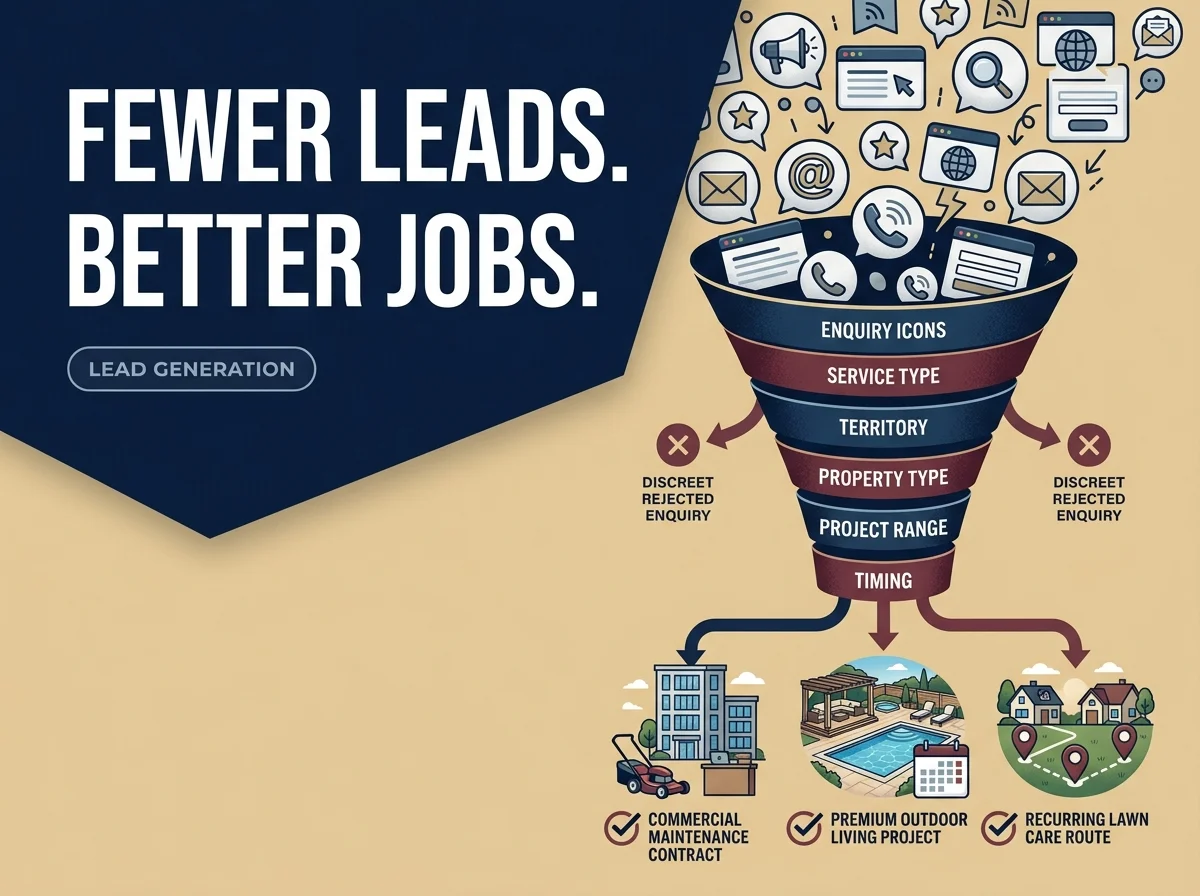
The cheapest landscaping lead can become the most expensive estimate on the calendar. Build the filter before you buy the traffic.
Want the research behind posts like this one?
One email a month: the numbers we check before each season, and the posts worth your time. Written for owners, not for inboxes.
One email a month. Practical, green industry only. Unsubscribe anytime.