
Lead Generation11 min read
How to Get Landscaping Leads Without Attracting Bad-Fit Work
The cheapest landscaping lead can become the most expensive estimate on the calendar. Build the filter before you buy the traffic.
On this page
Quick answer
To get landscaping leads that fit your business, define the service, property type, territory, timing and minimum job economics before you choose a channel. Carry those rules into the ad, landing page, form, phone script and CRM routing. The goal is fewer wasted estimates and more work your crews can deliver at the right margin.
Key takeaways
- Lead quality is designed upstream. The estimator should confirm fit, not discover the campaign targeted the wrong work.
Define a qualified lead in operating language
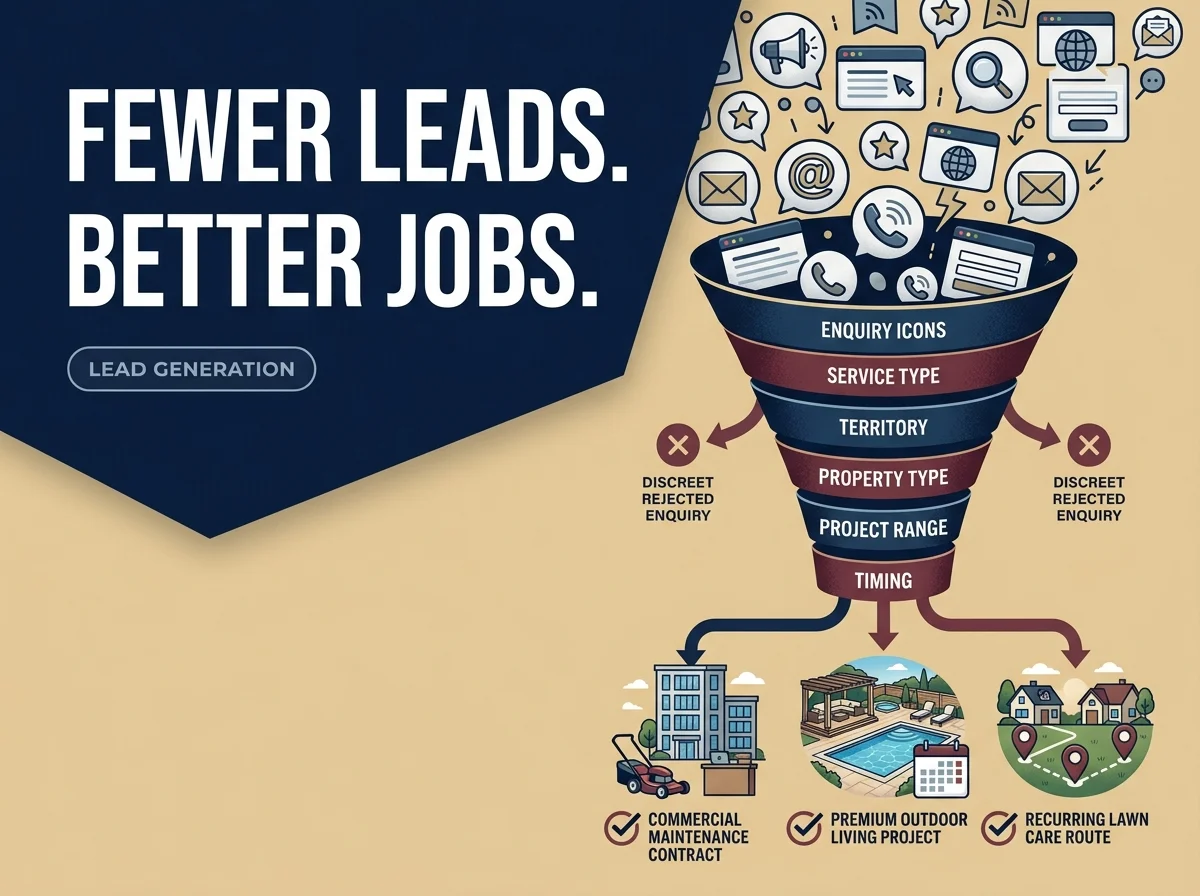
A qualified lead is not someone who filled a form. It is a prospect whose service need, property, territory, timing and commercial fit make a real estimate worthwhile. Write that definition separately for lawn care, design-build, commercial maintenance, irrigation, tree care and snow.
The definition should be short enough for the office to use during a call. If it requires a twenty-field spreadsheet, it will not survive the spring rush.
Make the ad do part of the filtering
Your headline, project image and first two lines should signal the job you want. A premium outdoor living campaign should show the scale and process of that work. A commercial maintenance campaign should speak to property standards, reporting and contract readiness.
Do not hide every boundary because you fear lower volume. Clear service and property language can reduce raw leads while improving the percentage that reaches an estimate.
Figure 2. A practical lead-quality scorecard. Illustrative framework, not client performance data.
| Signal | What it usually means | First fix | Measure next |
|---|---|---|---|
| High enquiry volume, low booking rate | The message is broad or the intake is weak | Split campaigns by service and add fit questions | Booked estimate rate |
| Many site visits, few proposals | The office is sending estimators to poor-fit jobs | Set property, territory and project rules | Site-visit-to-proposal rate |
| Proposals sent, low close rate | The offer, price signal or follow-up is unclear | Review proposal process and decision dates | Proposal-to-job rate |
| Jobs won, weak margin | The campaign sells work that production cannot deliver efficiently | Rank jobs by margin and route fit | Gross margin per won job |
Use project minimums carefully
A project minimum can save estimator time, but a blunt number without context can repel good prospects. Explain what the range usually includes, what changes price and when a phased option may make sense.
For recurring work, use contract size, property type, route fit and service frequency instead of a single project minimum. The purpose is to protect production economics, not to sound exclusive.
Ask questions that change a decision
Useful questions cover service, location, property type, timing, decision-maker status and expected scope. Each answer should route, prioritise or decline the request. If the team collects a detail and never uses it, remove the field.
Forms should stay shorter on mobile. Use the first response or call to complete the qualification rather than turning the form into a bid package.
Give every good lead one owner
The handoff should include source, campaign, service, answers, call notes, branch and response deadline. A lead that enters two inboxes often belongs to nobody.
Set overflow rules for absence, after-hours calls and territory conflicts. The prospect should not need to explain the property twice because the systems do not share context.
Measure the outcome after the lead
Report qualified rate, estimate booking, show rate, proposal rate, close rate, average job value and gross margin. Cost per lead still has a place, but it cannot be the final decision metric.
Feed unqualified and lost reasons back to the channel. That is how search terms, audiences, forms and scripts improve instead of producing the same bad-fit work every month.
What to do next
- Write one qualified-lead definition per service line.
- Remove form questions that do not change a decision.
- Assign one owner and one response deadline.
- Optimise channels toward booked estimates and won work.
lead generation for landscaping companies
Quick answers
Which channel produces the best landscaping leads?
The best channel depends on service intent and your operating capacity. Search often captures active demand. Paid social can create design-build interest. Referrals and local visibility can support trust. Compare channels by qualified booked estimates and margin, not by raw lead count.
Should a landscaping website show project minimums?
Show a price signal when it helps the buyer judge fit. Explain what the range covers and which variables move it. For commercial maintenance, describe property and contract fit instead of forcing a residential-style project minimum.
How many qualification questions should a form ask?
Ask the smallest number that lets the team route and prioritise the enquiry. Service, territory, property type and timing are common starting points. Complete the remaining context during the first response rather than burdening every mobile visitor.

Written by
Founder & CEO · Landscaping marketing specialist
Writes from the operating side of landscaping growth: demand, response, sales and the reporting that ties marketing spend to booked jobs.
Meet the team
AI Receptionists for Landscaping Companies: Rules Before Launch
Answering every call is useful only when the system knows the services, territory, schedule limits and exact moment a person takes over.

Google Ads for Landscapers: Budget Around Crew Capacity
The platform can spend faster than your crews can deliver. Pace the budget around the schedule, not around available clicks.
How to Grow a Landscaping Company Without Losing Margin
More leads rarely fix a growth problem. Before recommending a single campaign we run a four-part diagnostic, because most companies asking for more demand are actually constrained somewhere else entirely.
Want the research behind posts like this one?
One email a month: the numbers we check before each season, and the posts worth your time. Written for owners, not for inboxes.
One email a month. Practical, green industry only. Unsubscribe anytime.