
Growth12 min read
Landscaping Marketing Strategy: What to Fix Before Buying More Leads
More leads rarely fix a growth problem. This guide shows you how to find the constraint that is actually limiting booked work and margin.

On this page
Quick answer
A landscaping marketing strategy should start with the constraint that limits profitable delivery, not with a channel. Check response time, estimate conversion, crew capacity, route density and renewal risk before you increase demand. When the lowest-capacity stage improves, marketing has somewhere profitable to send the next enquiry.
Key takeaways
- The company grows at the speed of its weakest operating stage. Demand only helps when response, sales and delivery can absorb it.
Start with the operating equation, not the campaign
A marketing plan can create attention, calls and forms. It cannot create a trained foreman, shorten a forty-minute drive between mowing stops or make an estimator follow up on a proposal that has sat untouched for nine days. Those are operating constraints. Until you name them, every channel discussion starts too early.
Use a simple chain: demand, response, qualification, estimate, production and renewal. Put one owner and one measurable standard beside each stage. The stage that misses its standard most often is where the next month of effort belongs.
Measure capacity in crew days
Owners often say they have room for more work because the calendar contains white space. That can be misleading. Start with staffed hours for the next six to eight weeks. Remove committed contract work, expected weather loss, equipment maintenance, training and non-billable travel. What remains is sellable capacity.
Convert that number into crew days by service. A design-build crew, a maintenance route and an irrigation technician cannot absorb the same lead. Your budget should follow the capacity that exists, not the demand a platform says is available.
Figure 2. What the symptoms are telling you. Illustrative framework, not client performance data.
| Signal | What it usually means | First fix | Measure next |
|---|---|---|---|
| The phone is busy but the schedule is soft | Enquiries are not qualified or estimates are not converting | Review intake questions and estimate follow-up | Qualified-to-estimate rate |
| The schedule is full but cash is tight | Low-margin work, route waste or rework is consuming crew hours | Rank services by gross margin per crew hour | Margin per crew hour |
| Crews are booked eight weeks out | Demand is ahead of staffed production capacity | Throttle campaigns and reprice the backlog | Backlog in crew days |
| Revenue rises and renewals fall | Delivery or account communication is weakening | Start renewal work and service recovery earlier | Renewal rate and open issues |
Separate more revenue from better revenue
Rank service lines by gross margin per crew hour, repeat value, route fit, estimate effort and cash timing. The result usually changes what you ask marketing to sell. A recurring route may create steadier utilisation. A design agreement may pull winter cash forward. A commercial enhancement may look attractive but require scarce supervision.
This is why a single cost-per-lead target is weak. The company should know what it can pay for a booked estimate in each service line and what that job must contribute after production.
Fix response and sales before adding traffic
The first hour after an enquiry often exposes the real problem. Who owns the call? What happens when the office is dispatching? Does the estimator receive the service, territory, timing and property details, or call the prospect back to ask the same questions?
Write the handoff. Name the response standard. Give missed calls a recovery path. Then inspect the estimate pipeline by stage. A full lead report alongside an empty follow-up queue is not a marketing success.
Use seasonal stop rules
Spring does not give you time to discover that three campaigns are filling one estimator's calendar. Set stop rules before March. Examples include pausing a service when backlog crosses a defined number of crew days, narrowing territory when drive time rises, and reducing spend when response coverage falls below the company standard.
The November cliff needs a different rule. Shift from immediate installation demand toward renewals, design agreements, website work, automation and next-spring setup. Winter is an operating window, not a cheaper version of summer.
Run one weekly growth meeting
Keep the meeting to the numbers that move decisions: qualified enquiries, response time, estimates booked, close rate, backlog, margin per crew hour and renewal risk. Review exceptions, assign one owner and agree on the next action.
Do not use the meeting to read a dashboard aloud. The purpose is to decide where capacity moves, which campaign changes and which account needs intervention before the next week starts.
What to do next
- Name one current constraint in writing.
- Set one stop rule for every active campaign.
- Report cost per booked estimate, not only cost per lead.
- Review backlog and response coverage before budget changes.
landscaping lead generation services
growth packages from $2,000 per month
Quick answers
Should a busy landscaping company keep advertising?
Yes, but the campaign should match available capacity. Keep demand active for services, territories or seasons that can absorb work, and throttle the areas already overbooked. Turning everything off can create a later gap. Leaving everything open can create slow response and weak delivery.
What is the first number to review?
Start with gross margin per crew hour by service, then compare it with backlog and estimate conversion. Those three numbers show whether the problem sits in production, demand quality or sales. Lead volume alone cannot answer that question.
How often should the strategy change?
Review operating signals weekly and change the broader strategy monthly. Weather, staffing and backlog can move quickly during spring and fall, but constant campaign changes make the data unreadable. Use weekly stop rules inside a stable monthly plan.

Written by
Founder & CEO · Landscaping marketing specialist
Writes from the operating side of landscaping growth: demand, response, sales and the reporting that ties marketing spend to booked jobs.
Meet the team
AI Receptionists for Landscaping Companies: Rules Before Launch
Answering every call is useful only when the system knows the services, territory, schedule limits and exact moment a person takes over.

Google Ads for Landscapers: Budget Around Crew Capacity
The platform can spend faster than your crews can deliver. Pace the budget around the schedule, not around available clicks.
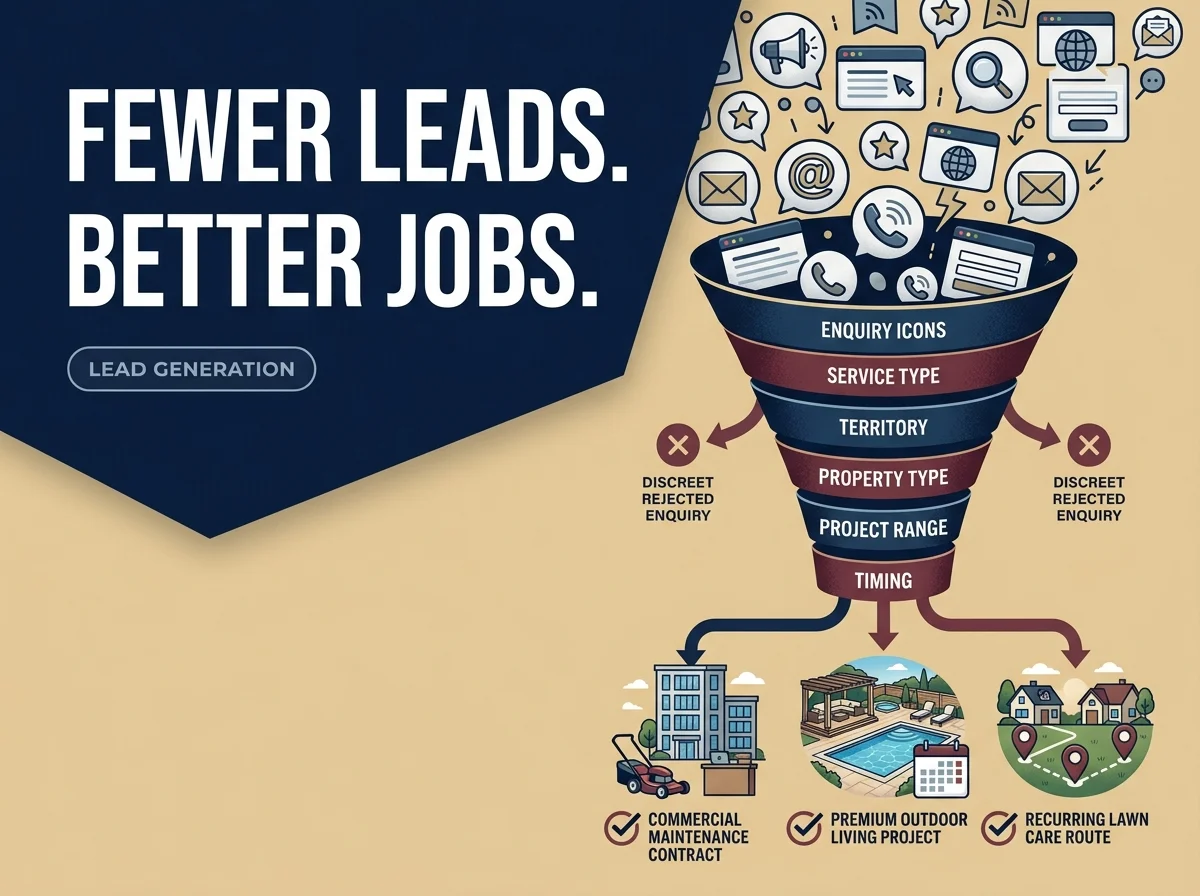
How to Get Landscaping Leads Without Attracting Bad-Fit Work
The cheapest landscaping lead can become the most expensive estimate on the calendar. Build the filter before you buy the traffic.
Want the research behind posts like this one?
One email a month: the numbers we check before each season, and the posts worth your time. Written for owners, not for inboxes.
One email a month. Practical, green industry only. Unsubscribe anytime.