
Local SEO12 min read
Google Business Profile for Landscaping Contractors: The Fields That Decide Who Gets Called
Most landscaping profiles are filled in once and never touched again. These are the fields that actually move you in the map, in the order a contractor should fix them, with what to do every month after that.
 By Umair SajidFounder & CEO · Landscaping marketing specialist
September 28, 2026

On this page
Quick answer
A Google Business Profile for contractors is won on a handful of fields: one accurate primary category, a services list that matches what your crews actually do, a service area set the way a business without a storefront should set it, hours that include the seasonal ones, and photos that arrive steadily rather than once. Reviews then decide the close. Most landscaping profiles fail on the first two, because the category was picked at signup and the services list was never filled in. Work down this page in order, then keep the monthly routine at the end.
If you would rather it was run for you, that is what we do here.
Key takeaways
- Primary category is the single most consequential field on the profile. Pick the one you want to be called for, not the broadest one.
- A service area business hides the address. Listing a house address you do not serve customers at causes more problems than it solves.
- Photos are a cadence, not a task. Recent work is what a buyer compares you on.
- The profile decides whether you appear. The reviews and the landing page decide whether you get the call.
The fields that matter, in the order to fix them
There are dozens of fields on a profile and they are not equal. This is the order we work through on a growth audit, and it is roughly the order of impact for a green industry company. The profile is one step inside the wider picture we set out in organic growth for landscaping companies.
| Order | Field | What gets it wrong | What right looks like |
|---|---|---|---|
| 1 | Primary category | Picked at signup and forgotten, often too broad | The category matching the work you want more of |
| 2 | Secondary categories | Empty, or stuffed with everything | Only services you genuinely deliver with your own crews |
| 3 | Services | Blank, or the default list Google suggests | Your real service names, each with a short description |
| 4 | Service area | A radius covering three states | The towns your crews actually reach on a normal week |
| 5 | Hours and special hours | Set once, never seasonal | Real hours, plus the seasonal and holiday changes |
| 6 | Photos | A logo and two old jobs | New work added on a steady cadence |
| 7 | Website link | The homepage for every service | The page matching the primary category |
| 8 | Description | Written for the company | Written for the buyer, with the services named |
| 9 | Attributes and Q&A | Ignored | Answered before a customer has to ask |
Nothing below the line matters much if the top three are wrong. A tree company listed under a general landscaping category with no services filled in will keep losing calls to smaller companies that got those three fields right.
Google Business Profile categories for contractors, trade by trade
Category is the strongest signal Google has for what you do, and it shapes which searches you show up in. One primary, then secondaries for the work you really do. The pattern that works is: primary equals the highest margin work you want more of, secondaries equal the rest of the truck.
| Your business | Primary category to look for | Secondaries worth adding |
|---|---|---|
| Full service landscaping | Landscaper | Lawn care, landscape design, snow removal |
| Maintenance and lawn care | Lawn care service | Landscaper, fertilizing or turf treatment |
| Design build | Landscape designer | Landscaper, paving, pool construction where you build them |
| Hardscaping | Paving contractor | Landscaper, masonry |
| Tree care | Tree service | Arborist service, stump grinding, landscaper. The trade side of this is in tree service SEO |
| Irrigation | Lawn sprinkler system contractor | Landscaper, and plumbing only where you are licensed |
| Snow and ice | Snow removal service | Landscaper, lawn care |
Do not open a second profile to cover a second category. One business, one profile, unless you genuinely run separate staffed locations.
Service area without an address
Almost every landscaping company is a service area business: customers do not come to you. Google supports that directly, and the setup is simple once you accept two rules.
- If customers never visit you, Google's own business information guidelines say the address should not be shown. A yard or home office shown publicly also invites walk ins you do not want and tends to produce mismatched listings. Google's business information guidelines, checked September 2026.
- Set the service area as the towns or regions you genuinely serve, not the largest circle you can draw. A wildly oversized area does not make you rank wider, and it makes your profile less relevant to the places you actually work.
Where you have a real yard with staff and signage that customers do visit, keep the address visible and treat that location as the anchor of your map presence. What you cannot do is claim locations you do not staff.

If your map rankings have gone flat despite a complete profile, the cause is usually elsewhere. We wrote about the usual suspects in why map rankings stall.
Photos: what to shoot and when
Photos do one job that is documented and one that is obvious. Google says photos help customers choose you, and every owner who has watched a profile knows the listing with recent, real work gets the call over the one with a logo and two old jobs. Treat them as a conversion asset, not as a ranking lever. Crews already carry the camera, so the problem is never equipment, it is routine.
| When | What to shoot | Why |
|---|---|---|
| End of every job | The finished area, wide and straight on | Proof of standard, and the buyer sees their own property type |
| Mid job, once a week | Crew working, equipment in use | Shows a real operation rather than a stock image |
| Monthly | Trucks, team, yard | Answers the silent question about whether you are established |
| Seasonally | The service of that season | Keeps the profile current with what people are searching for |
Shoot in daylight, hold the phone level, keep faces out unless you have permission, and never upload a photo that shows a property in a state you would not want associated with your name. If each crew photographs one finished job a day, a two crew company ends the week with ten. That is the cadence, and it costs nobody an extra hour.

Reviews, questions and the parts people ignore
Reviews sit beside the profile rather than inside it, and they decide the close more than the ranking. Three rules cover most of it.
- Ask once, at the moment the work is finished and the customer is happy, from the person who did the work.
- Never offer anything in exchange for a review, and never ask only the customers you expect to be happy. Both break Google's review policies, and in the US review gating also falls under the FTC rule on fake and deceptive reviews, 16 CFR Part 465. Both checked September 2026.
- Reply to all of them, including the bad ones, with specifics and without arguing. The reply is written for the next reader, not for the reviewer.
Questions and answers are the most ignored surface on the profile. You are allowed to post the questions customers actually ask and answer them yourself. Do the five you answer on every call: minimum job size, whether you do emergency work, whether you are insured, how far you travel, and what the season looks like.
Profile posts sit beside the questions and take about ten minutes. They are worth writing when something is genuinely time bound: a seasonal service opening, a storm response, a cut off date for fall work. They are not worth writing weekly for the sake of it, and nothing Google publishes says posting more often moves the map.
What not to bother with
Half of the advice written about profiles is filler that costs a contractor real hours. These are the ones we tell owners to skip.
| The advice | Why it is skipped | Do this instead |
|---|---|---|
| Keyword stuffing the business name | It breaks Google's naming rules and puts the profile at risk | Use the name on the truck and the invoice |
| Weekly posts with no news | Ten minutes a week for no effect anyone can show | Post only when something is genuinely time bound |
| A second profile for a second category | Duplicate listings compete with each other and invite removal | One profile, correct categories |
| A service area covering three states | It does not widen your reach and dilutes relevance | The towns your crews reach on a normal week |
| Buying review packages | Against Google policy and against US law | One request after every completed job |
Time saved there is better spent on photos and on answering the phone faster, both of which the buyer actually sees.
The monthly routine
A profile decays. Categories get suggested, hours drift, competitors get edited by strangers, photos age. Thirty minutes a month holds it.
| Check | Looking for | If it is wrong |
|---|---|---|
| Category and services | Changes you did not make | Reset them and note the date |
| Hours | Seasonal drift, holidays | Update, including special hours |
| Photos | Anything newer than 30 days | Upload the last month of finished jobs |
| Reviews | Unanswered ones | Reply to all, oldest first |
| Questions | New questions from the public | Answer within the week |
| Performance report | Calls, direction requests, searches | Compare to last month and to last year |
Record the numbers somewhere you will see them next to job data. A profile that produces more calls but fewer booked jobs is telling you something about intake, not about search. That is the part most agencies stop at and the part that actually decides whether the work was worth it. Our wider local SEO work starts from the same place.

What to do next
- Open the profile and check the primary category against the work you want more of.
- Fill the services list with your real service names and a line of description each.
- Set the service area to the towns your crews reach on a normal week, and hide the address if customers never visit.
- Upload six photos from the last month of finished jobs, and put photo collection into the job close checklist.
- Answer the ten questions you get on every call, in the Q and A section, in your own words.
See how we run Google Business Profile work
Frequently asked questions
Should a landscaping company show its address on Google?
Only if customers actually visit that location and it is staffed. Most landscaping companies serve customers at their properties, so the address should be hidden and the service area set to the towns the crews reach.
How many categories should a contractor add?
One primary that matches the work you want more of, and only the secondaries you can genuinely staff. A short honest list beats a long one, because every category you add invites calls you may not want.
How often should photos be added?
Weekly is a realistic cadence for a company running crews, because every finished job is a photo. Recent work is what the buyer compares, so six photos from last month do more than a large old gallery.
Can I ask customers for reviews?
Yes, as long as you ask everyone rather than selecting the happy ones, and you offer nothing in return. Asking at the moment the crew finishes, from the person who did the work, produces the highest response rate.
Does the profile replace a website?
No. The profile decides whether you appear and gets you the click. The page behind it decides whether the visit turns into an estimate, which is why the website link should point at the page matching your primary category.
Written by
Founder & CEO · Landscaping marketing specialist
Writes from the operating side of landscaping growth: demand, response, sales and the reporting that ties marketing spend to booked jobs.
Meet the team
AI Receptionists for Landscaping Companies: Rules Before Launch
Answering every call is useful only when the system knows the services, territory, schedule limits and exact moment a person takes over.

Google Ads for Landscapers: Budget Around Crew Capacity
The platform can spend faster than your crews can deliver. Pace the budget around the schedule, not around available clicks.
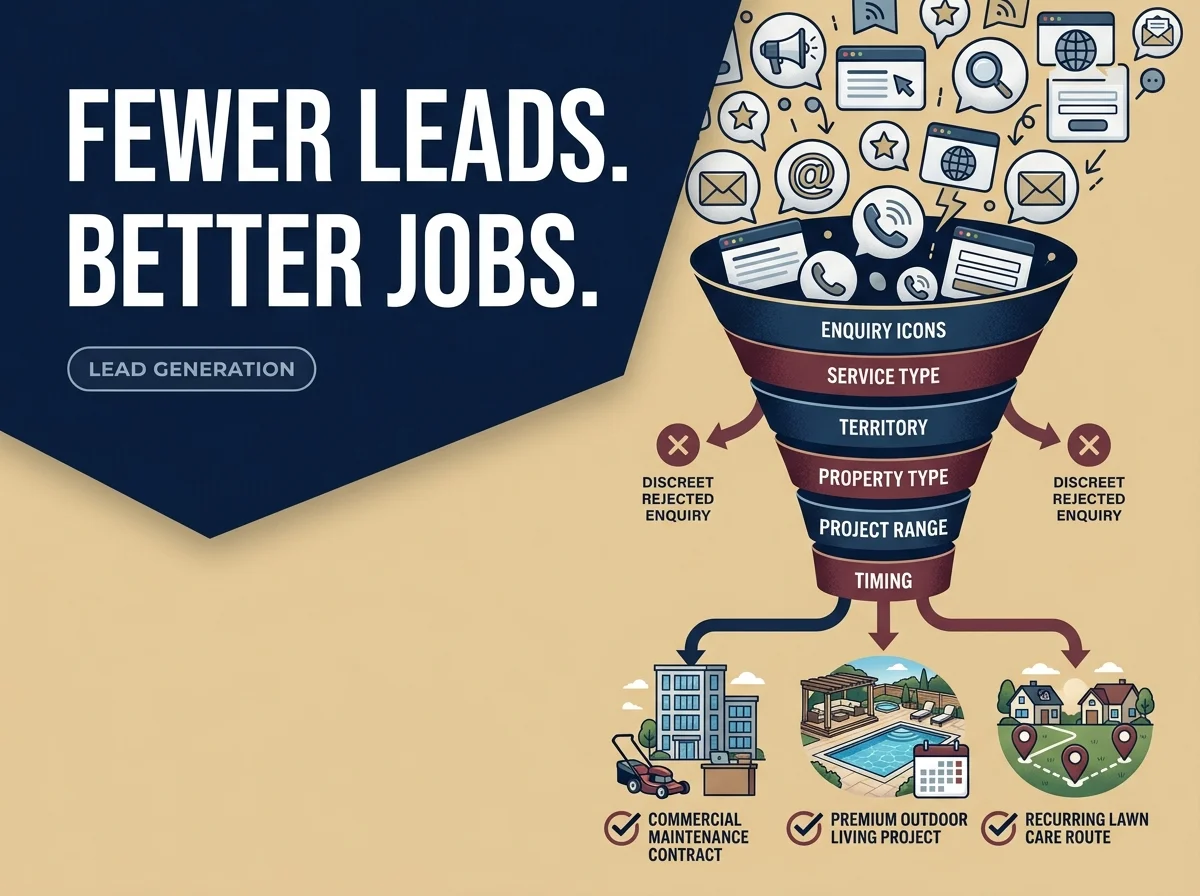
How to Get Landscaping Leads Without Attracting Bad-Fit Work
The cheapest landscaping lead can become the most expensive estimate on the calendar. Build the filter before you buy the traffic.
Want the research behind posts like this one?
One email a month: the numbers we check before each season, and the posts worth your time. Written for owners, not for inboxes.
One email a month. Practical, green industry only. Unsubscribe anytime.