
Local SEO13 min read
Local SEO for Landscapers: Why Map Rankings Stall
Map visibility stalls when the profile, branch, service pages and operating evidence tell different stories. Fix the system, not one field.
On this page
Quick answer
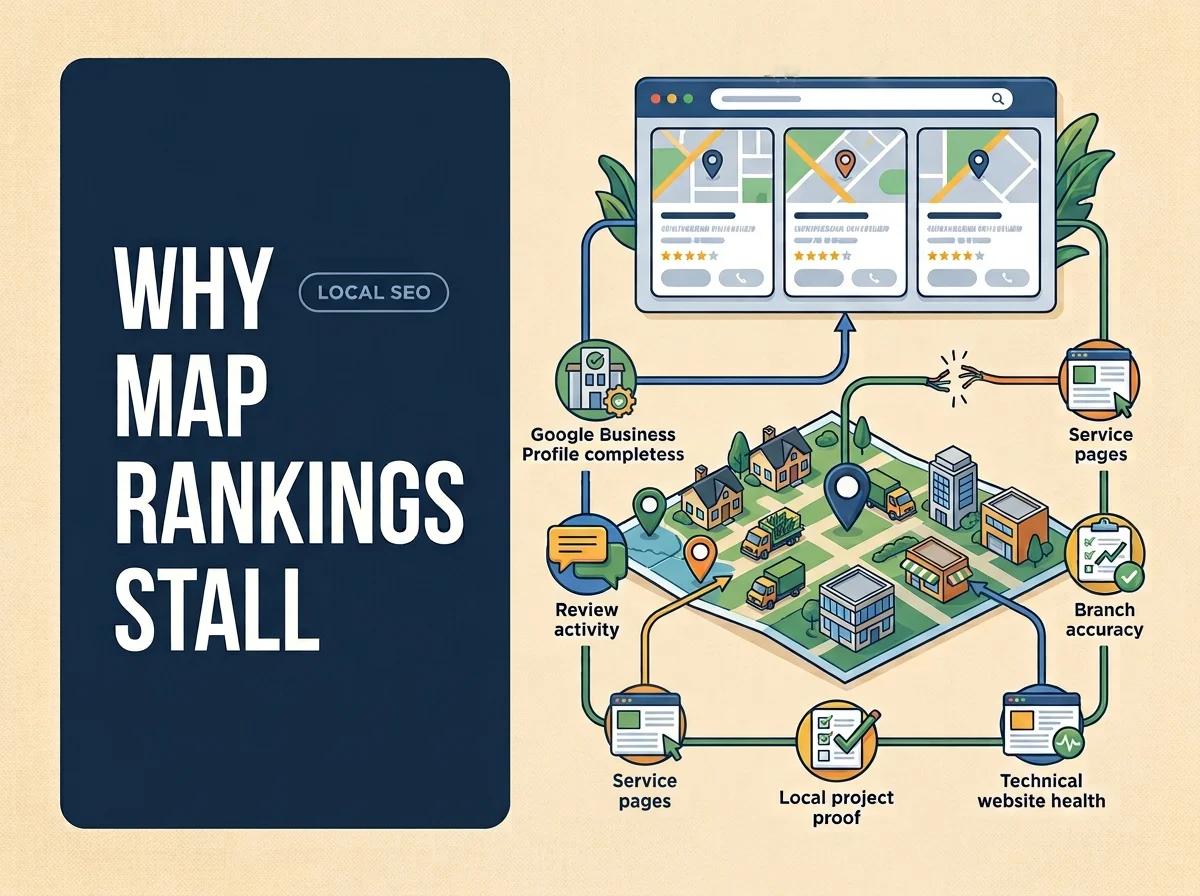
Local SEO for landscapers stalls when Google Business Profile data, branch pages, service coverage, reviews, project proof and technical website signals do not agree. Start with ownership and business data, then align each branch with real services, local evidence and a useful page. Rankings follow a consistent operating presence, not a copied location template.
Key takeaways
- A map listing is the front door of a local entity. The website, reviews, branches and service evidence have to support it.
Secure ownership before optimisation
The company should know who owns every profile, which account holds primary access and who can approve changes. Shared personal logins and old agency accounts create risk before any ranking work begins.
Build a branch record for name, address or service-area settings, phone, hours, categories, services, manager, page URL and verification status. That becomes the source the website and reporting follow.
Make services match the branch operation
Do not list every service the company has ever performed. Match each branch to the work it actively sells, staffs and supports. A branch with maintenance crews but no design capacity should not promise the same service mix as the head office.
Figure 2. Why local visibility stalls. Illustrative framework, not client performance data.
| Signal | What it usually means | First fix | Measure next |
|---|---|---|---|
| Profile impressions rise, calls do not | The listing is visible but service fit or proof is weak | Improve services, photos, branch page and call path | Qualified calls |
| One branch ranks, another does not | Branch evidence and data are inconsistent | Build a complete branch record and unique page | Actions by branch |
| Pages index but earn no local traffic | The pages repeat the same service copy | Add territory, property, crew and project context | Qualified organic visits |
| Reviews grow but rankings stay flat | Other entity or technical signals are weak | Audit categories, duplicates, internal links and crawl health | Map visibility by service |
Use the same language on the profile, branch page and service pages. The buyer and the search engine should see one operating reality.
Build branch pages with local evidence
A branch page needs more than a place name. Explain the property types, service mix, route or territory coverage, team ownership, seasonal demand and next step. Add approved projects, photographs and reviews where they exist.
When proof is limited, show the process and state the limitation. Thin copies create more URLs without creating more trust.
Use service-area pages selectively
Create a page when the territory matters to the buyer and the company can add unique operational detail. Service schedule, crew coverage, property patterns, seasonal work and project examples can justify the page.
Do not create dozens of pages that swap town names. They compete with each other, increase maintenance and give the reader no new reason to call.
Run reviews as an operating process
Ask after completed work or an approved milestone. Keep the request neutral and make service recovery the priority when an issue is open. The customer chooses the wording and rating.
Respond with specific context without exposing private details. A branch-level review process helps visibility, but it also shows the market how the company communicates.
Maintain technical and internal signals
Local pages still need crawlable links, useful titles, mobile performance, working forms and consistent phone tracking. Link branch pages to relevant services and link service pages back to the branches that deliver them.
Audit duplicates, edits, services, hours, photos, broken links and conversions monthly. Local SEO is maintenance work tied to the operation, not a one-time listing setup.
What to do next
- Create one verified branch record.
- Align profile services with staffed branch capacity.
- Publish unique local operating evidence.
- Review profiles, pages and conversions every month.
local SEO for landscaping companies
Quick answers
How long does local SEO take for a landscaping company?
Technical and profile corrections can happen quickly, but meaningful search movement usually needs months of consistent work. Expect the timeline to depend on competition, branch history, website quality, reviews and the strength of local evidence. Do not promise a specific ranking date.
Should a service-area business hide its address?
Use the profile settings that match how the company serves customers and the platform rules that apply to the business. The website should still publish accurate branch and contact information where appropriate. Do not use a mailbox or false location to create visibility.
How many service-area pages should a landscaper publish?
Publish only the pages the company can support with real service coverage and unique operating detail. A smaller set of useful pages is stronger than a large set of copied locations that add no proof, process or buyer context.

Written by
Founder & CEO · Landscaping marketing specialist
Writes from the operating side of landscaping growth: demand, response, sales and the reporting that ties marketing spend to booked jobs.
Meet the team
AI Receptionists for Landscaping Companies: Rules Before Launch
Answering every call is useful only when the system knows the services, territory, schedule limits and exact moment a person takes over.

Google Ads for Landscapers: Budget Around Crew Capacity
The platform can spend faster than your crews can deliver. Pace the budget around the schedule, not around available clicks.
How to Get Landscaping Leads Without Attracting Bad-Fit Work
The cheapest landscaping lead can become the most expensive estimate on the calendar. Build the filter before you buy the traffic.
Want the research behind posts like this one?
One email a month: the numbers we check before each season, and the posts worth your time. Written for owners, not for inboxes.
One email a month. Practical, green industry only. Unsubscribe anytime.